
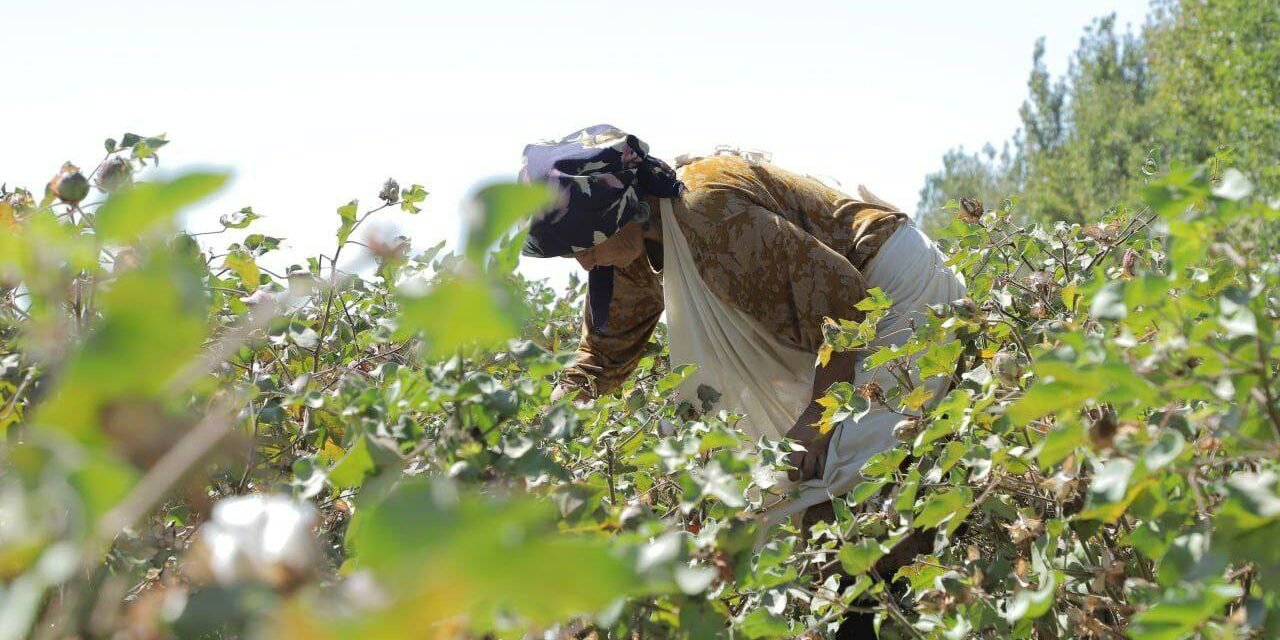
Isolated cases of forced labor point to deeper structural contradictions in how cotton production in Uzbekistan is still managed.
Uzbekistan has spent the last decade working to reform its notorious cotton sector, which once relied on one of the world’s largest state-run systems of forced labor. But as the 2025 cotton harvest showed, the state’s administrative control over the sector and unfinished reforms continue to harbor the old practice of forcing residents to pick cotton or pay for replacement pickers when there are not enough people willing to go to the fields voluntarily.
While Uzbekistan has made significant progress in dismantling its centralized system of government-organized forced labor in cotton harvesting, coercive practices have not been entirely eliminated.
Despite the fact that the entire cotton crop produced by farmers is delivered to private cotton processing companies, the so-called cotton clusters, the government continues to closely oversee the harvest. Daily cotton schedule meetings are still held with local officials to ensure that farmers meet a daily picking quota of roughly 4 percent of their overall production quota.
Local authorities remain trapped in the government’s contradictory cotton production system: despite official prohibition of forced labor, regional and district hokims (governors) are expected to deliver swift harvest results in accordance with pre-determined production quotas set by the state, even when there is a shortage of voluntary pickers. In order to avoid punitive measures for failing to meet their daily cotton harvest schedules, forced mobilization appears to be the only viable option which in turn leads to prosecution when they are found out.
Mobilization of State Employees
The 2025 cotton harvest concluded on November 1, with the government announcing that 100 percent of the planned quota, just under 3.8 million tons, had been met. Reports from the ground indicate that the season was not much different from last year, with sporadic reports of regional officials pressuring people to go out to the fields.
At the height of the cotton harvest in October 2025, 32 employees of an Information and Library Center in Uzbekistan’s Bukhara region went to pick cotton. According to a handwritten “information note” provided by a farmer from Bukhara district, the librarians collected 1,503 kilograms of cotton on October 5, 2025.
Following inquiries from local media, the library administration submitted a written response signed by the 32 employees, stating that they “had gone to the fields voluntarily, on their day off, in order to earn additional income.” However, after the case became public, the State Labor Inspectorate, apparently unconvinced by the claim of voluntary participation, held the head of the center administratively liable for “administrative coercion to work,” an offense punishable by a fine.
Earlier, in mid-September, the media had reported that state employees in regions that were lagging behind the schedule were being sent to pick cotton. In Kashkadarya, a worker from the district water supply department said eight colleagues had been dispatched overnight. Elsewhere, heads of government agencies unrelated to agriculture were appointed as “authorized representatives” to help farmers meet quotas. Every evening, they were required to report on progress.
In one tragic case, the head of a gas company in Nishon district in Kashkadarya region was killed in a car accident on October 3 after attending one such late-night meeting. Exhausted from the burden of an additional job, he had apparently fallen asleep at the wheel.
Bank employees, too, were quietly ordered to pick cotton on weekends or pay someone to go in their place. Blogger and former banker Otabek Bakirov wrote that low-level bank staff, already under heavy workloads, would never complain publicly because the orders were verbal and the risk of losing their jobs was real.
These isolated cases of forced labor point to deeper structural contradictions in how cotton production in Uzbekistan is still managed. At the start of the harvest, many farmers cannot afford to offer wages high enough to attract sufficient numbers of voluntary pickers. Inflation and rising living costs have seen a significant reduction in the numbers of people willing to pick cotton, as they choose other seasonal employment that offers higher wages.
Rather than granting farmers the right to choose whether or not to grow cotton, especially when it is not economically viable for them to do so, authorities appear to be focusing on a different solution to the sector’s persistent labor shortages: expanding mechanized harvesting.
Toward the end of 2025, Uzbek President Shavkat Mirziyoyev outlined key priorities for the agricultural sector in 2026. These included the cultivation of cotton on all 891,000 hectares under the so-called “76th scheme” by 2026 – a configuration designed to make fields fully compatible with mechanized harvesting. Under this plan, the government aims to achieve 85 percent machine harvesting of all Uzbek cotton.
State Control
The introduction of mass mechanized harvesting indicates that the government may intend to push again for some meaningful reforms that have largely stalled since 2021. Uzbekistan’s cotton sector remains under the tight control of the government and no longer appears to be committed to upholding the reforms laid out in its own agricultural strategy. The 2020-2030 agricultural development strategy envisaged “abandoning the practice of state-mandated crop allocation” by the first quarter of 2023. That has yet to happen.
In 2020, Mirziyoyev signed a decree announcing the abolition of state-imposed production quotas and pricing of cotton. In practice, however, the state continues to require farmers to grow a fixed volume of cotton on designated land, as stipulated in their contracts. Farmers are not permitted to use land allocated for cotton cultivation to grow alternative, potentially more profitable, crops. Although official pricing for Uzbek cotton is reportedly linked to global market prices, it has remained largely unchanged over the past three years. During the same period, global cotton prices have declined, making cotton cultivation increasingly unprofitable for Uzbek farmers.
The government’s addiction to control of the cotton sector reflects a deeper and historic problem that preserves the Soviet method of imposing quotas and a system that measures success by tonnage of cotton and not by market efficiency or profitability for farmers.
For Uzbekistan’s international partners, including development banks, which continue to finance agricultural modernization and water-saving technologies, these findings should be concerning. Reform on paper is not enough. Uzbekistan must finally abandon the centralized quota system and implement agricultural reforms that eliminate any need for forced labor and create an agriculture sector in which all players, including farmers, can thrive.
This article by Umida Niyazova was first published by The Diplomat on January 22, 2026
Source: Uzbekforum.org