Safeguards exist on paper, but are development banks prepared to confront the political realities that prevent those safeguards from functioning in practice?
The Asian Development Bank’s (ADB) “zero tolerance” policy on reprisals against activists and communities is an important step forward to strengthen the protection of those who monitor and report on rights violations related to international development projects. But at the ADB’s annual meeting in Samarkand earlier this month, that commitment collided head-on with the political realities of modern Uzbekistan.
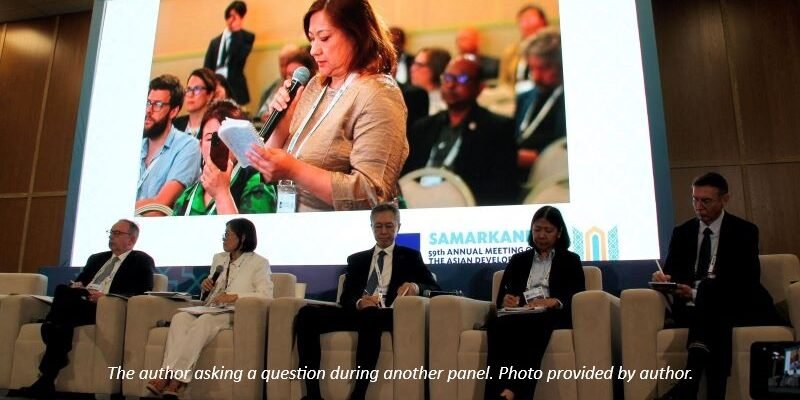
From May 3-6, the ADB held its Annual Meeting in Samarkand, attended by government officials, bankers, investors, and civil society representatives. I was invited, in my capacity as founder and director of the Uzbek Forum for Human Rights (Uzbek Forum), to speak on a panel discussing the impact of retaliations on “constructive consultations, accountability, and grievance mechanisms” in ADB-financed projects.
Ironically, upon arriving in Tashkent, I discovered that the Uzbek authorities had refused to confirm my registration along with two other participants affiliated with Uzbek Forum for unspecified “security reasons.” After initially being given assurance that we could take part, the decision was quickly reversed. We were finally told that we could participate, with restricted access, and that the main venue where official sessions were taking place would be off limits.
No one explained what exactly these “security concerns” were, or whose security was supposedly under threat from a human rights organization officially registered in Berlin. Uzbekistan’s Ministry of Investment, Industry and Trade, which was coordinating with the ADB, informed the bank that it had no objection to Uzbek Forum’s participation, but could not influence decisions made by the country’s security apparatus. It is difficult to imagine a more fitting illustration of the very issue under discussion: a civil society representative being obstructed from taking part in a panel about repression against civil society.To the ADB’s credit, they continued negotiations after initially proposing that I participate remotely, despite the fact that I had already traveled from Berlin to Samarkand. Had this arrangement gone ahead, it would have resulted in a deeply paradoxical situation: delivering a presentation on retaliations via Zoom from a hotel room located only a short distance from the conference venue, while simultaneously being denied permission to enter it.
The incident unfolded against the backdrop of Uzbekistan’s growing partnership with the ADB. Another package of $12.5 billion in investments was announced, adding to the $5.4 billion in loans the bank has issued over the past five years. According to the ADB’s country partnership strategy for 2024-2028, the bank aims to support Uzbekistan’s transition to a green economy, strengthen the private sector, and invest in human capital.
The carefully curated public image of a “New Uzbekistan,” as an open, reforming, and rapidly developing economy, has successfully obscured a deeply constrained civil society in which freedoms of speech and association remain severely limited.
During the ADB meeting in Samarkand, Uzbek authorities appeared determined to remind activists of that reality. Several Uzbek activists who had traveled to Samarkand to meet with ADB representatives received phone calls from local police or district administrations. One individual who approached a human rights defender from Karakalpakstan insisted on speaking privately and claimed to represent the “mahalla association,” Uzbekistan’s neighborhood-level governance structure. He claimed that all Uzbek activists had been assigned an “assistant” to help with any “needs” they might have while attending the conference. Other activists reported having to explain to local officials why they were attending the meeting in Samarkand and one was warned to “think carefully before saying anything.”
For Uzbek activists, such intimidation is hardly new. Yet the timing was striking. As Bruce Dunn, director of the ADB Office of Safeguards, stated during our panel, “development should not come at the cost of communities and those who speak up.” The bank’s Environmental and Social Framework, approved in November 2024, explicitly states that acts of retaliation contradict the institution’s core values and mission. In Samarkand, that commitment faced a real-time test.
Ensuring public participation is a basic obligation of development banks. The ability of civil society and people affected by projects to raise their concerns without fear of reprisal is key to ensure effective risk assessment and due diligence and ultimately leads to better project design and outcomes. In Uzbekistan, however, the entire notion of public participation is undermined by a hollowed-out civil society following decades of repression and authoritarian rule. Journalists and activists who emerged during the country’s recent period of relative openness frequently self-censor to avoid political red lines, particularly concerning grand corruption and foreign investments.
In recent years, Uzbek Forum monitored the highly controversial “Indorama Agro” cotton project, financed by the ADB, the European Bank for Reconstruction and Development (EBRD), and the International Finance Corporation (IFC). Monitoring of the project resulted in retaliations against workers, including surveillance, illegal dismissals, and union-busting practices, while independent activists were threatened by the authorities for documenting human rights violations. In one case, a local monitor was detained by police for several hours and pressured into signing a statement pledging not to share information with foreign organizations. Although such statements carry little legal force, they serve as powerful instruments of intimidation. The activist was left too afraid to participate in the ADB’s Annual Meeting. In another case, a monitor was threatened with criminal charges after interviewing Indorama Agro workers. Following these incidents, Uzbek Forum was forced to suspend its monitoring of the project in order to protect the safety of local activists and workers.
The Uzbek authorities’ capacity to silence critical voices raises a difficult but unavoidable question: how can the ADB’s policy of zero tolerance for reprisals function effectively in environments where civil society is weak, freedom of expression remains tightly controlled, and local communities are too frightened to speak out or seek legal protection?
While Uzbek Forum acknowledges and appreciates the genuine willingness within the ADB to engage with civil society and strengthen accountability, a zero tolerance policy on reprisals can only function effectively if people are able to report abuses safely in the first place. The case of Indorama Agro demonstrated how even when people are brave enough to speak out, the ADB, EBRD, and IFC lacked a sufficient process to address a pattern of reprisals that persisted over a period of at least three years.
The question facing the ADB and other development banks investing in Uzbekistan is not whether safeguards exist on paper, but whether they are prepared to confront the political realities that prevent those safeguards from functioning in practice. International financial institutions must not shy away from exerting their considerable leverage and demonstrate political will to effectively ensure public participation in a country considered to be “closed.”
Author: Umida Niyazova
Source: The Diplomat